 Image 1 of 1
Acrylic on Linen
60” x 84” x 2.5”
2008
This work engages directly with the legacy of Abstract Expressionism—not through homage but through productive confrontation. Upon viewing Pollock's drip paintings, Artiles experienced what he describes as an extreme urge to paint on top of them, to find imagery within the gestural chaos and push it forward into contemporary relevance. The result is a complex negotiation between two distinct historical moments in abstraction.
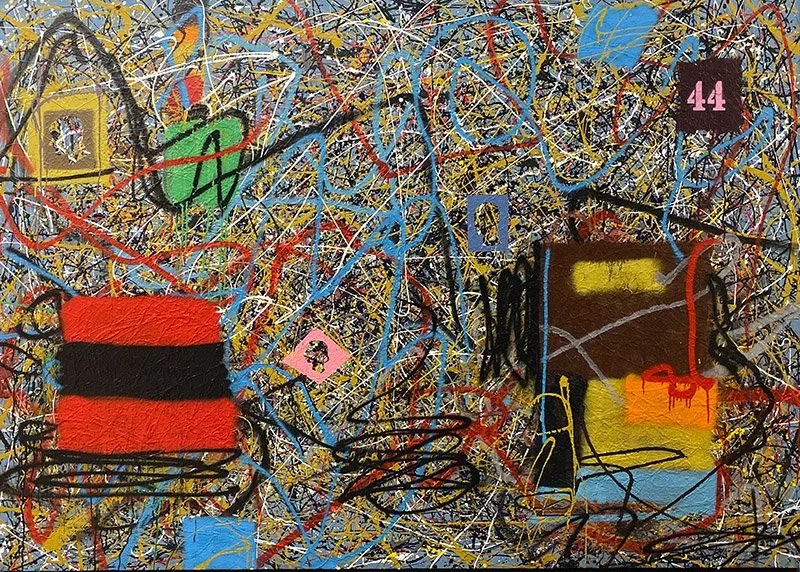
The surface begins with Pollock's vocabulary—the flung skeins of paint, the all-over composition, the denial of representational space. But where Pollock sought to eliminate the image entirely, recognitionism insists on its inevitable return. Artiles doesn't impose imagery from outside; he discovers it within the gestural field itself—faces emerging from the splatter, figures coalescing from accidental marks, the human presence that abstract expressionism worked so hard to expunge. The geometric elements—bold rectangles in red and black, yellow passages, blue structures—serve not as the recognized forms but as framing devices, contemporary signs that anchor the work in a specific historical moment.
The "44" is deliberately specific—a reference to the 2008 presidential race that would make Barack Obama the 44th president. It grounds the painting in a moment of profound social transformation, suggesting that abstraction, far from existing in hermetic isolation, registers the pressures and possibilities of its time. This isn't Pollock's postwar existential theater but a 21st-century understanding that we cannot unsee the image, cannot return to pure abstraction's founding gesture.
What makes this work significant is its theoretical intelligence about painting's history. It acknowledges that after decades of conceptual art, appropriation, and the return of figuration, we look at Pollock differently now—we see things in those drips that weren't supposed to be there. Recognitionism names this condition and makes it method. For collectors engaged with contemporary painting's self-aware relationship to its own history, this piece offers both visual complexity and art-historical resonance.
Acrylic on Linen
60” x 84” x 2.5”
2008
This work engages directly with the legacy of Abstract Expressionism—not through homage but through productive confrontation. Upon viewing Pollock's drip paintings, Artiles experienced what he describes as an extreme urge to paint on top of them, to find imagery within the gestural chaos and push it forward into contemporary relevance. The result is a complex negotiation between two distinct historical moments in abstraction.
The surface begins with Pollock's vocabulary—the flung skeins of paint, the all-over composition, the denial of representational space. But where Pollock sought to eliminate the image entirely, recognitionism insists on its inevitable return. Artiles doesn't impose imagery from outside; he discovers it within the gestural field itself—faces emerging from the splatter, figures coalescing from accidental marks, the human presence that abstract expressionism worked so hard to expunge. The geometric elements—bold rectangles in red and black, yellow passages, blue structures—serve not as the recognized forms but as framing devices, contemporary signs that anchor the work in a specific historical moment.
The "44" is deliberately specific—a reference to the 2008 presidential race that would make Barack Obama the 44th president. It grounds the painting in a moment of profound social transformation, suggesting that abstraction, far from existing in hermetic isolation, registers the pressures and possibilities of its time. This isn't Pollock's postwar existential theater but a 21st-century understanding that we cannot unsee the image, cannot return to pure abstraction's founding gesture.
What makes this work significant is its theoretical intelligence about painting's history. It acknowledges that after decades of conceptual art, appropriation, and the return of figuration, we look at Pollock differently now—we see things in those drips that weren't supposed to be there. Recognitionism names this condition and makes it method. For collectors engaged with contemporary painting's self-aware relationship to its own history, this piece offers both visual complexity and art-historical resonance.